Peak Oil, Peak Everything
By Peter Goodchild

http://www.survivepeakoil.blogspot.ca/2016/02/peak-oil-peak-everything.html
Perhaps the most common response to the peak-oil problem is: "The oil isn't going to disappear overnight. We have a century to prepare." Unfortunately, the fact that the decline in oil is a curve, not a vertical line, makes it difficult to comprehend. What matters is that the serious damage will have been done long before we get to those tiny remaining drops. That damage started around 1970, and it was not confined to oil.


http://www.survivepeakoil.blogspot.ca/2016/02/peak-oil-peak-everything.html
Perhaps the most common response to the peak-oil problem is: "The oil isn't going to disappear overnight. We have a century to prepare." Unfortunately, the fact that the decline in oil is a curve, not a vertical line, makes it difficult to comprehend. What matters is that the serious damage will have been done long before we get to those tiny remaining drops. That damage started around 1970, and it was not confined to oil.
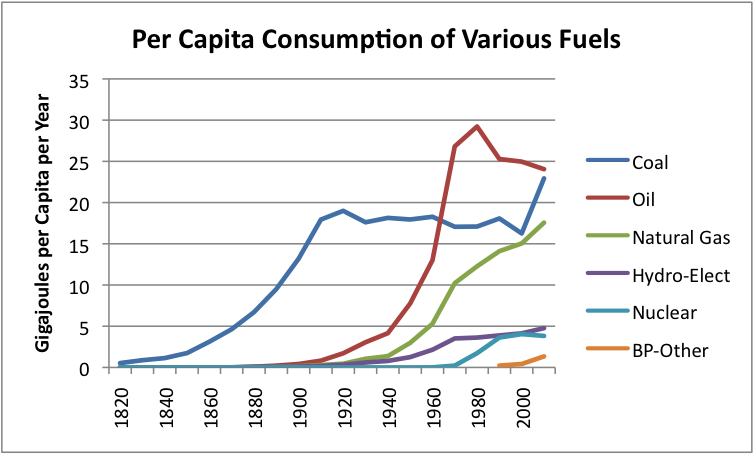
Also, there are "curves within curves," so to speak. "Peak oil" in an ABSOLUTE sense was around 2010, but "peak oil" PER CAPITA was 1979, when there were 5.5 barrels of oil per person annually. According to UN estimates (admittedly quite uncertain), the world's population will rise to about 8 billion or more in 2030, whereas a look at the usual (or, at least, realistic) estimates for oil production show a decline to about 15 billion barrels in 2030, giving us a "per capita" figure of less than 2 barrels. That figure will not constitute an "on/off" situation, but by that year 2030 the human race should probably say goodbye to the Oil Economy.
It is not only oil, but in fact the entire North American economy that has followed something like a bell curve. In many ways it was not 2010, or any other year in the early 21st century, but the year 1970, that was the Peak, the Big Peak of Everything. Backward or forward on that curve, we see a dirty, noisy, crowded world. Right on that Peak, we see the Golden Age -- Beatlemania, "sex, drugs, and rock 'n' roll," Easy Street. As Dickens might say, "It was the best of times, it was the worst of times." The gap between the rich and the poor was not so bad in those days, whereas according to the US Census Bureau the mean income of the richest 5 percent of American families began to skyrocket shortly before 1970. In the year 1968, there was the Tet offensive, the turning point of the Vietnam War -- from an American military point of view, the downturn. In the year 1969, there was the first moon landing -- "the Space Age" began, although within a few years the expression (like "the Atomic Age") would be just an embarrassment.
The above-mentioned statement, "We have a century to prepare," also raises the question: Who is the "we" here? All human beings? A small group of dedicated survivalists? If the answer is the former, then the statement is false: humanity, as a whole, never makes any decisions. The human race, taken in its entirety, simply does not behave in such a sophisticated manner; the human race much prefers ignorance, superstition, cruelty, and intolerance. Robert Kaplan's book The Ends of the Earth is one of many texts that elucidate the harsh reality of human nature.
What about the coming several decades? Of course, a great deal depends on which time period one is discussing: the world of 2100 will be very different from the world of 2030. The question of slow versus fast collapse will also have a big effect on future scenarios. But if we look at tangible events of the last hundred years, two possible conceptions of the future stand out most clearly. These have best been illustrated by novelists (although not with peak oil as the setting) rather than by sociologists.
The first is that of a slow slide into an impoverished police state, as illustrated by George Orwell’s 1984. In this scenario, government does not disappear. It is here to curse us forever. We may be poor and living in chaos, but we will live in relentless drudgery. This is roughly the same scenario as that of the Great Depression of the 1930s.
The second is that of a nuclear war that throws humanity back into a quasi-medieval world, as in Walter M. Miller, Jr., A Canticle for Leibowitz. In the fight for the remaining resources, civilization is largely destroyed. Such a scenario is just as plausible as that of George Orwell.
All civilizations grow too large to support themselves, and their leaders have little foresight. These civilizations then collapse and are buried in the sand. The same will happen to American civilization, but human shortsightedness prevents us from seeing it as only one among many. The USA, in other words, is seen as "civilization" in a generic sense, when it is really just one single civilization in a quantifiable sense. Unlike that of ancient Egypt, however, it is not likely to have a lifespan of three thousand years. Nor is it likely that another will take its place.
Watch More


